Hippoi Athanatoi
Dogs, horses, books, MU*ing, and a bit of this and that. Sometimes regular, sometimes highly irregular. Plenty of older content, we'll see what happens going forward.
- Obsessing About the Lymond Chronicles
- Written on the Dark
- The Wars of Light and Shadow
- More Belated Book Talk
- What I Read in 2023

I now have two unfinished book posts that have been sitting around for over a year and here I am writing a third instead. This time, I blame Dorothy Dunnett. I had not really planned a reread of the Lymond Chronicles, but then I started and well, you know how it goes.
If you have not read the Lymond Chronicles, they are a series of six books following the fictional Francis Crawford of Lymond in the mid 16th century across Scotland, England, France, Russia and the Ottoman Empire. It is as historically faithful as the author could make it while introducing the most brilliant man ever. Yes, if you have an issue with utterly brilliant protagonists, you will not like these books. Though make no mistake, Lymond (as he prefers to be called most of the time) has plenty of flaws to balance his amazing talents.
Spoilers for the whole series as well as some spoilers for Janny Wurts’s Wars of Light and Shadow follow.
I don’t quite recall when I first came across Dorothy Dunnett, though it may have been through recommendations from Guy Gavriel Kay, who is a huge fan of her writing and one can certainly see the influence from her in his own books. Diarmuid from the Fionavar Tapestry echoes Lymond in his appearance as well as elements of his personality (the charm, the flamboyance and the wildness of spirit and the way both of them can go from light-hearted to deadly serious in an instant), Ammar from The Lions of Al-Rassan has much of Lymond’s brilliance as a strategist, swordsman and artist. I do believe Kay may have credited Dunnett for showing him that you can write about extraordinary, larger-than-life characters.
This reread was only my second time through the chronicles, despite how much of an impression they made on me the first time around. However, they are not easy reads. The first book, Game of Kings, is particularly baroque in style and there were large sections of the book where I found it incredibly hard to understand what was going on. I swear, I lost track of Lymond for a whole section of the book! And now that I tackled the series for the second time, I was made very aware of how much I had missed in the later books too. In some senses, it was almost like reading a whole new series, which was a delightful experience.
Lymond is one of those characters that leaves me completely obsessed. He is brilliant and beautiful and the amount of mental and physical torture that Dunnett puts him through is utterly heartbreaking. His mother describes him as “high-strung”, but he has the ability to act as if nothing touches him, at least until it all breaks down after a few books of suffering. He tries his best to keep his friends at a distance, often hurting them in the process, and then somehow they still end up dying for him. You are almost safer being an enemy of Lymond’s than a friend.
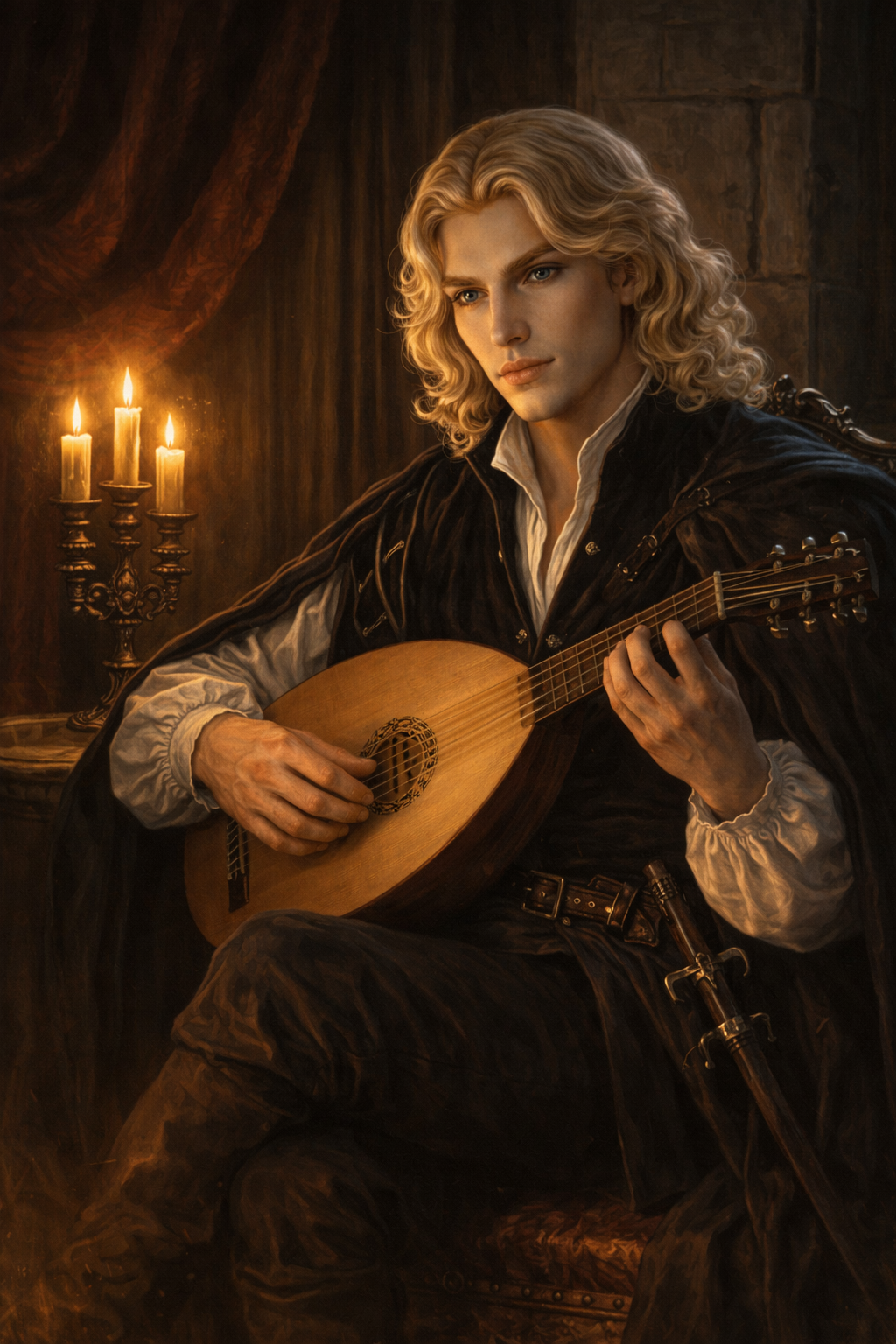
I couldn’t help but to try to use AI to picture what Lymond might look like. This one I think captures the inspiration from the Della Robbia angels quite nicely.
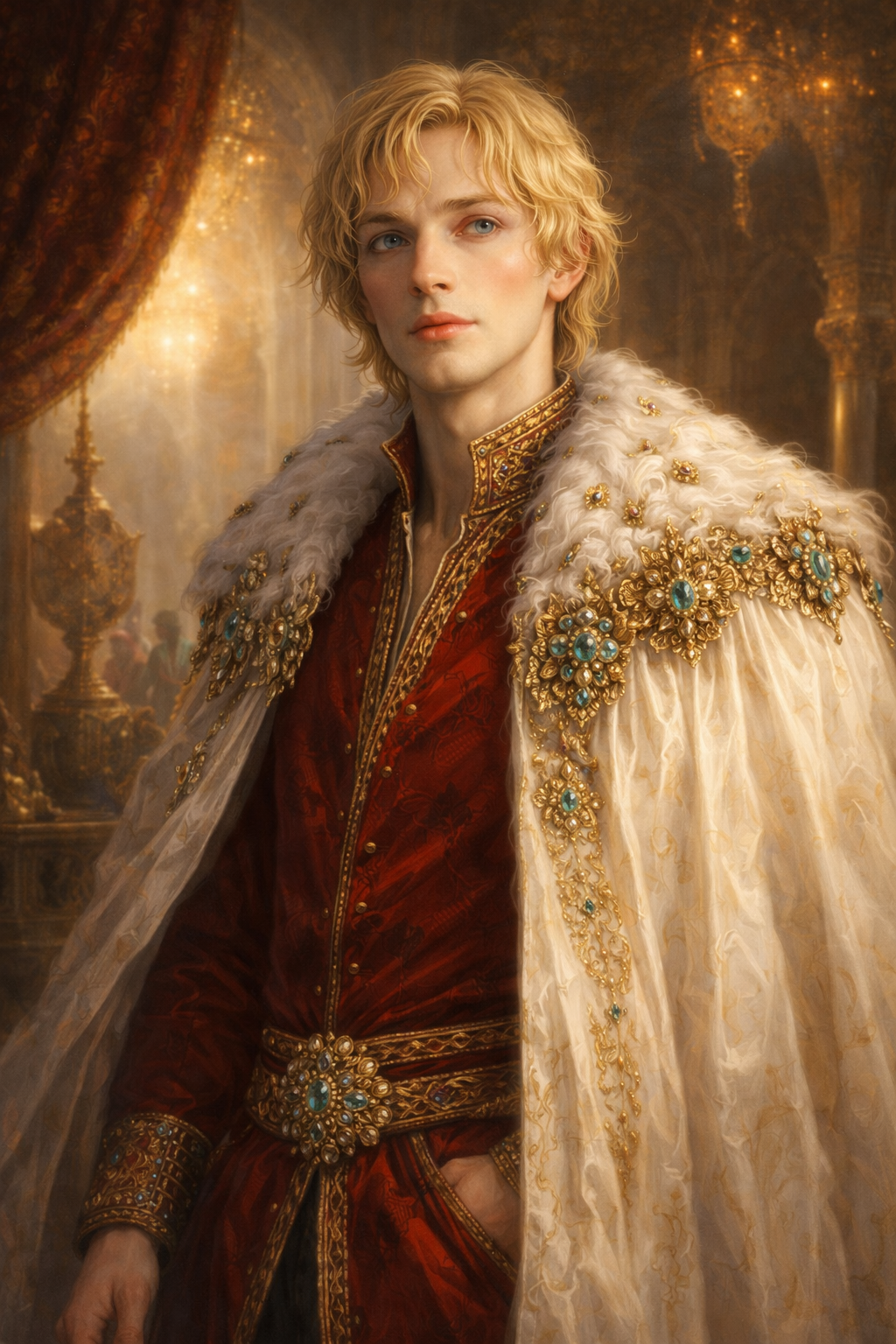
But this one, on the other hand, looks like a high-strung person to me.
If you are a reader of epic fantasy and this reminds you of someone else, then you would be right if you are thinking of Arithon from Janny Wurts’s Wars of Light and Shadow (and possibly others, Dunnett has influenced more than a few writers). I wrote about my read of the whole series two years ago, when the last book came out, and reading the Lymond Chronicles with the Wars of Light and Shadow relatively fresh in my mind was an interesting experience.
Both Lymond and Arithon are brilliant men whose greatest love in life is music, but circumstances often keep them from their art, much to the detriment of their souls. They are physically similar (shorter, slighter men, still very physically capable, though Lymond’s blonde hair and stunning beauty appears to have gone to Arithon’s half-brother Lysaer) and share many emotional traits (ultimately very sensitive but can appear hard and cold, using wit and sarcasm to protect themselves, preferring to keep friends at a distance to avoid hurting them). And while the Lymond Chronicles are very grounded in history, they do contain supernatural elements such as predicting the future. Indeed, Lymond’s own birth appears to be the result of plans made by an astrologer and mystic called the Dame de Doubtance, to bring forth a “man of destiny”. With the whole story of the Wars of Light and Shadow now revealed, this seems like it may also have been part of the inspiration behind the Biedar engineering the birth of Arithon to set right the problems caused by the Koriathain stealing knowledge from them.
Another author who also has noted the influence of Dunnett on her work is Jacqueline Carey. There’s no Lymond-esque character in the Kushiel novels (Phèdre is no slouch when it comes to being brilliant, but she’s far too well-adjusted), but I do think there are elements of similarity between Lymond’s arch nemesis Gabriel and Melisande. In particular, there’s a scene where they encounter Gabriel in a very unexpected situation and it reminded me so much of the reveal of Melisande in La Serenissima. That said, Melisande may be extremely ambitious and ruthless, but she is not a sociopath and Gabriel most certainly is.
Returning to the Lymond Chronicles, I find myself at that stage where I desperately want to talk about these books with someone, hence the somewhat rambling post going over various impressions and associations. Oh to have been around when they first came out! There is certainly an active Facebook group still, but stumbling into a well-established fandom to repeat old questions is always a little difficult. But, I do have to set down a speculation of mine here, since I have not been able to find any evidence of it having been discussed. I am certain people must have hit on this idea before, but likely those discussions happened well before Facebook.
At the end of the last book, Checkmate, Sybilla explains that the Dame de Doubtance wanted a son by the first Francis Crawford who could do what “the times had been wrong for the first baron to do“. She first attempted to create this son by engineering a match with her own daughter Beatris, which produced a son that was also named Francis (and later, a daughter as well). But this son turned out to be sickly and died when he was only ten years old. That is when she brought Francis and Sybilla together again and another son named Francis, our Lymond, was born. She had succeeded, albeit ten years later than first intended. And this may matter.
But what was it that he was supposed to do? What was it that she had seen? If we go back to Pawn in Frankincense, there’s the scene where Philippa speaks to the Dame. When Philippa is trying to find out where Lymond’s son is, the Dame says that after the child is found, “Francis has to meet and kill Graham Malett.” She then makes it sound as if it would be better for certain people (including herself) if this did not happen. And yet, when Philippa persists, the Dame’s face “changed and glittered and finally held back between aged cross-curtains the ghost of a lost, true delight”. It seems as if she is pleased after all, as if perhaps the killing of Graham Malett is very important.
I think she had foreseen the threat of Gabriel (in Pawn, we see how powerful he has become). Gabriel is older than Lymond, perhaps not precisely ten years (there’s apparently a family tree that incorporates notes from hints by Dunnett that has him born 6-7 years before Lymond), but if her her first attempt at a son by the first baron had succeeded they would have been more of an age. As it is, Gabriel is almost too powerful for Lymond to handle. It may be that the Dame suspects this and that is why she tries to turn Philippa from that path, perhaps until she sees that Philippa will indeed be strong enough to help Lymond? It is also telling that once Gabriel has been defeated, and Lymond has survived his opium addiction thanks to Marthe, the Dame dies.
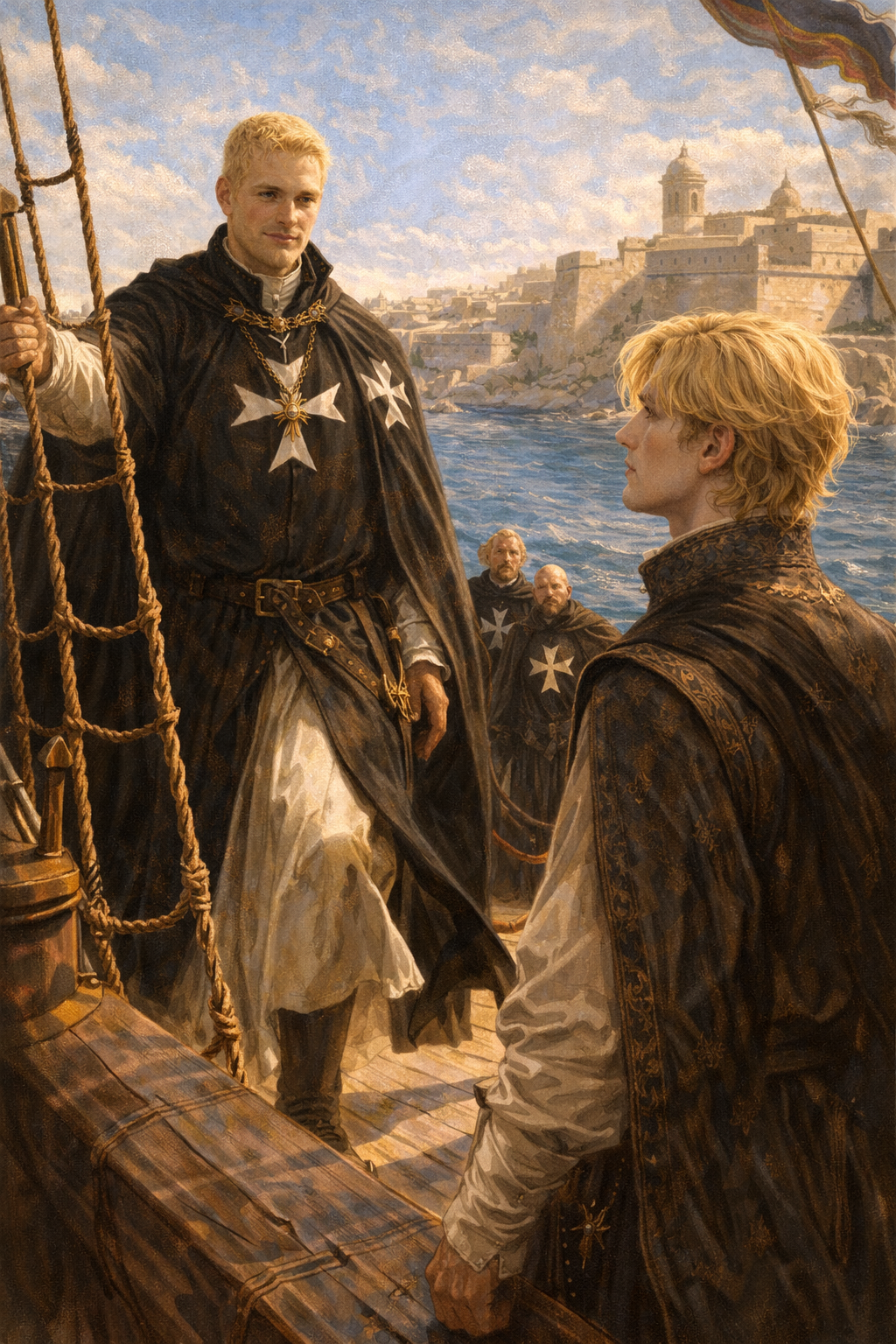
That meeting.
But was there more that the Dame had hoped would be possible for Lymond, but which perhaps won’t happen now because of his age? There are some intriguing references to Lymond being too young – indeed, specifically ten years too young, which would not have been the case had the first son by Beatris lived. For example, Oonagh thinks to herself (of Lymond) that “had she been born ten years later (he) might have been her first and only love”. That would also have worked if he was ten years older. Was she supposed to be his match? Philippa would certainly have been too young. Another connection to Ireland in particular is that it is ten years ago that they were annexed by the English – could this have been different as well, had Lymond been older?
Finally, in Checkmate we have this exchange:
“I am sad,’ said the Bishop of Orkney to Lord James Stewart as the tables were gently drawn and the floor cleared and the candied ginger passed from place to place. ‘I am sad because we live, you and I, on two sides of one river. And whoso list to hunt, I know where is an hart we both covet.’
‘There is a remedy,’ said the Queen’s half-brother.
‘Is there? I doubt it,’ said Reid of Orkney. ‘There might have been, in the past. But this hart is ten years too young, I fear, for his destiny.’”
As always, Dunnett’s writing is difficult to unpack. But it seems the Bishop suggests that there is a man that both Scotland and England wants to court. Lord James thinks there is a remedy, but the Bishop says that this man (obviously Lymond) is ten years too young for his destiny. Precisely what the remedy could have been (Or how it might have existed in the past – is he talking about the first baron? Or Gabriel if he had not been evil?), had things been different, is unclear to me. But it does seem to suggest that had Lymond been born when the Dame first intended, he could have had more of a role in the future of Scotland and England.
The very final lines of Checkmate have been discussed at length by fans and there are different opinions on what it means for the future of Francis and Philippa. Is there still a destiny for them foreseen by the Dame de Doubtance? I am uncertain, because when Marthe is mistaken for Lymond and killed by Austin Grey, there is a voice from someone that says: “It is finished. Remember me no longer; or my children, or my children’s children.” That is the Dame, speaking about how now she is gone and so are her children and her children’s children. I think this also strongly suggests that what she foresaw Lymond being able to affect has come to an end. Perhaps it would have been different if he had been ten years older, but as it is the rest of history will have to manage. This is also a neat solution to the fact that unless Dunnett wanted to presume an alternate history going forward, our hero could only have had limited influence over the challenges facing Scotland under Queen Mary.
No doubt Francis and Philippa went on to lead interesting lives, I cannot imagine them just sitting at home reading and making music, but I rather hope they didn’t have to go off on quite such crazy adventures again.